
Summary
Contents
Subject index
This 42 chapter volume represents the state of the art in visual research. It provides an introduction to the field for a variety of visual researchers: scholars and graduate students in art, sociology, anthropology, communication, education, cultural studies, women's studies, ethnic studies, global studies and related social science and humanities disciplines.
The SAGE Handbook of Visual Research Methods encompasses the breadth and depth of the field, and points the way to future research possibilities. It illustrates “cutting edge” as well as long-standing and recognized practices. This text is not only “about” research, it is also an example of the way that the visual can be incorporated in data collection and the presentation of research findings. Contributors to the book are from diverse backgrounds and include both established names in the field and rising stars. Chapters describe a methodology or analytical framework, its strengths and limitations, possible fields of application and practical guidelines on how to apply the method or technique.
The Sage Handbook of Visual Research Methods is organized into seven main sections:
Framing the Field of Visual Research; Producing Visual Data and Insight; Participatory and Subject-Centered Approaches; Analytical Frameworks and Approaches; Vizualization Technologies and Practices; Moving Beyond the Visual; Options and Issues for Using and Presenting Visual Research
Visual Research Methods in the Design Process
Visual Research Methods in the Design Process
Introduction
Design, like the arts, is often regarded as a visual discipline. The design disciplines have, throughout their histories, actively engaged visual methods of problem-solving. Architecture, industrial design, graphic design, and interior design—some of the core design disciplines—clearly employ a variety of visual techniques in their standard praxis. The creation of aesthetically appealing artifacts is often described as one of design's primary goals and, therefore, the research that is conducted in the design disciplines includes several visual methods. These typically include photography, videography, sketching, diagramming, storyboarding, model-making, prototyping, and so on. A variety of visual practices exist as a central component of all phases of design methodology, from the early research in understanding user needs and leading up to the final implementation or manufacturing. In fact, one may say that design as a discipline has been obsessed with the visual ever since its inception. However, the growing use of ethnography in design (mostly observations, interviews, surveys, etc.) might, in some ways, signal somewhat of a turn away from the visual. In the world of product design, a project that focuses primarily on designing an object's shape or form is often referred to as ‘styling,’ and some designers are offended to be referred to as stylists. They believe that their work extends beyond the visual. Designers are embracing the notion that their task is to solve people's real needs, not merely create beautiful artifacts. Therefore, while there may be a growing recognition and acceptance of visual research methods in the social sciences, design research, over the past few years, seems to be trying to get beyond the visual.
Understanding Design
What is design? This question is continually asked by scholars within the design community, and the answers vary widely, in part due to the relative youth of the design disciplines. In addition, as it evolves, design takes on new meanings, adopts new methodologies, addresses a broader range of problems, and redefines its scope, making it challenging to find a singular definition. A comparative study by Atwood et al. (2002) demonstrates some of the semantic diversity that exists in the various definitions of design (Figure 8.1).
Figure 8.1 Diversity in definitions of design, an updated version of the diagram from Atwood et al. (2002)
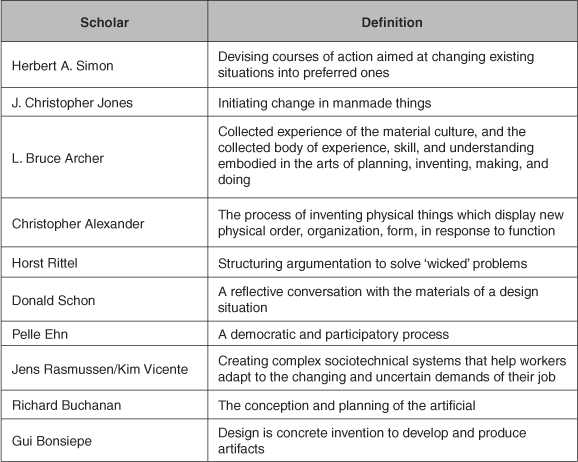
The authors explain that this list is by no means exhaustive; the individual definitions represent a small sample extracted from seminal definitions that scholars have formulated over time. Some common threads do emerge from this diversity. It is clear, for instance, that all design is a form of problem-solving and planning for the future. The employment of such terms as ‘action,’ ‘change,’ ‘inventing,’ and ‘creating’ in these definitions establishes design as a generative process of transformation that leads to tangible outcomes. If the goal of design, as Max Bill of the Hochschule für Gestaltung in Ulm once explained, is ‘to participate in the making of a new culture—from spoon to city’ (Lindinger, 1991: 10), its scope is vast and the diversity in definitions is only to be expected.
...
- Loading...
Get a 30 day FREE TRIAL
-
 Watch videos from a variety of sources bringing classroom topics to life
 -
Read modern, diverse business cases
-
Explore hundreds of books and reference titles

Read next

More like this
Sage Recommends
We found other relevant content for you on other Sage platforms.
Have you created a personal profile? Login or create a profile so that you can save clips, playlists and searches