
Entry
Reader's guide
Entries A-Z
Normalization
In many popular statistical models, we assume that some component of a variable Y has a NORMAL DISTRIBUTION. For example, in the linear regression model Y = α + βX + ε, we typically assume that the error term ε is normal. Although minor departures from normality may be acceptable, distributions with heavier-than-normal tails can compromise statistical estimates. In such cases, it may be preferable to transform Y so that the pertinent component is closer to normality. Transforming a variable in this way is called normalization.
If the pertinent component of Y has one heavy tail (skewed), then we often apply a power transformation. True to their name, power transformations raise Y to some power p (i.e., they transform Y into Yp). Powers greater than 1 reduce negative skew: An example is the quadratic transformation Y 2(p = 2). Powers between 0 and 1 reduce positive skew: An example is the square-root transformation or √Y or √Y + 1/2 (p = 0.5), which is common when Y represents counts or frequencies. For a power of 0, the power transformation is defined to be log(Y), which reduces positive skew in much the same way as a very small power. Negative powers have the same effect as positive powers applied to the reciprocal 1/Y and are used when the reciprocal has a natural interpretation—as when Y is a rate (events per unit time), so that 1 Y is the time between events.
In sum, the family of power transformations can be written as follows:
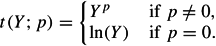
Power transformations assume that Y is positive; if Y can be zero or negative, we commonly make Y positive by adding a constant. There are formal procedures for estimating the best constant to add, as well as the power p that yields the best approximation to normality (Box & Cox, 1964). However, the optimal power and additive constant are usually treated only as rough guidelines.
If the pertinent component of Y has two heavy tails (excess KURTOSIS), we may use a modulus transformation (John & Draper, 1980),

which is a modified power transformation applied to each tail separately. Non-negative powers p less than 1 reduce kurtosis, while powers greater than 1 increase kurtosis. Again, there are formal procedures for estimating the optimal power p (John & Draper, 1980). If Y is symmetric around 0, then the modulus transformation will change the kurtosis without introducing skew. If Y is not centered at 0, it may be advisable to add a constant before applying the modulus transformation.
Other normalizations are typically used if Y represents proportions between 0 and 1: the arcsine or angular transformation sin−1(√Y), the logit or logistic transformation  , and the probit transformation Φ−1 (Y) where Φ−1 is the inverse of the cumulative standard normal density. The logit and probit are better normalizations than the arcsine, which is gradually disappearing from practice.
Even the best transformation may not provide an adequate approximation to normality. Moreover, a transformed variable may be hard to interpret, and conclusions drawn from it may not apply to the original, untransformed variable (Levin, Liukkonen, & Levine, 1996). Fortunately, modern researchers often have good alternatives to normalization. When working with non-normal data, we can use a GENERALIZED LINEAR MODEL that assumes a different type of distribution. Or we can make weaker assumptions by using statistics that are “distribution-free” or nonparametric.
...
- Analysis of Variance
- Association and Correlation
- Association
- Association Model
- Asymmetric Measures
- Biserial Correlation
- Canonical Correlation Analysis
- Correlation
- Correspondence Analysis
- Intraclass Correlation
- Multiple Correlation
- Part Correlation
- Partial Correlation
- Pearson's Correlation Coefficient
- Semipartial Correlation
- Simple Correlation (Regression)
- Spearman Correlation Coefficient
- Strength of Association
- Symmetric Measures
- Basic Qualitative Research
- Basic Statistics
- F Ratio
- N(n)
- t-Test
- X¯
- Y Variable
- z-Test
- Alternative Hypothesis
- Average
- Bar Graph
- Bell-Shaped Curve
- Bimodal
- Case
- Causal Modeling
- Cell
- Covariance
- Cumulative Frequency Polygon
- Data
- Dependent Variable
- Dispersion
- Exploratory Data Analysis
- Frequency Distribution
- Histogram
- Hypothesis
- Independent Variable
- Measures of Central Tendency
- Median
- Null Hypothesis
- Pie Chart
- Regression
- Standard Deviation
- Statistic
- Causal Modeling
- DISCOURSE/CONVERSATION ANALYSIS
- Econometrics
- Epistemology
- Ethnography
- Evaluation
- Event History Analysis
- Experimental Design
- Factor Analysis and Related Techniques
- Feminist Methodology
- Generalized Linear Models
- HISTORICAL/COMPARATIVE
- Interviewing in Qualitative Research
- Latent Variable Model
- LIFE HISTORY/BIOGRAPHY
- LOG-LINEAR MODELS (CATEGORICAL DEPENDENT VARIABLES)
- Longitudinal Analysis
- Mathematics and Formal Models
- Measurement Level
- Measurement Testing and Classification
- Multilevel Analysis
- Multiple Regression
- Qualitative Data Analysis
- Sampling in Qualitative Research
- Sampling in Surveys
- Scaling
- Significance Testing
- Simple Regression
- Survey Design
- Time Series
- ARIMA
- Box-Jenkins Modeling
- Cointegration
- Detrending
- Durbin-Watson Statistic
- Error Correction Models
- Forecasting
- Granger Causality
- Interrupted Time-Series Design
- Intervention Analysis
- Lag Structure
- Moving Average
- Periodicity
- Serial Correlation
- Spectral Analysis
- Time-Series Cross-Section (TSCS) Models
- Time-Series Data (Analysis/Design)
- Trend Analysis
Get a 30 day FREE TRIAL
-
 Watch videos from a variety of sources bringing classroom topics to life
 -
Read modern, diverse business cases
-
Explore hundreds of books and reference titles

Read next

More like this
Sage Recommends
We found other relevant content for you on other Sage platforms.
Have you created a personal profile? Login or create a profile so that you can save clips, playlists and searches