
Entry
Reader's guide
Entries A-Z
Nonadditive
Nonadditive is a term used to describe a function that relates one set of scores (e.g., scores on a variable, Y) to two or more other sets of scores (e.g., scores on variables X1 and X2). The relationship between Y and the other variables is said to be additive if Y can be expressed as a sum of those other variables. The sum can be a weighted sum and has the general expression

where a and the various ws are constants.
In some applications, restrictions are placed on the constants. For example, if a = 0 and each weight is set to 1.0, then Y is literally the sum of the X variables. Another type of restriction that a researcher might apply is that the weights must sum to 1.0 in accordance with the formulation
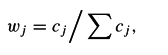
where cj is an absolute weight for variable Xj. The summation is across the k weights. As an example, suppose that Y is an additive function of X1 and X2, and that a = 0,c1 = 1, and c2 = 1. Then, w1 = 1/(1 + 1) = 0.50, and w2 = 1/(1 + 1) = 0.50, yielding

Note that this expression is equivalent to

so that Y is the average of X1 and X2. This example shows that expressing Y as an average of a set of variables is a type of additive function.
A nonadditive function is one where Y cannot be expressed as a (weighted) sum of the other variables. Nonadditive functions can take many forms—indeed, there is an infinite number of such functions. An example of a nonadditive function is a MULTIPLICATIVE function, where Y is said to equal the product of two variables, X1 and X2.
Traditional multiple regression analysis is based on an additive model,

where α is the intercept and the various βs are the REGRESSION COEFFICIENTS.
Reference
- Analysis of Variance
- Association and Correlation
- Association
- Association Model
- Asymmetric Measures
- Biserial Correlation
- Canonical Correlation Analysis
- Correlation
- Correspondence Analysis
- Intraclass Correlation
- Multiple Correlation
- Part Correlation
- Partial Correlation
- Pearson's Correlation Coefficient
- Semipartial Correlation
- Simple Correlation (Regression)
- Spearman Correlation Coefficient
- Strength of Association
- Symmetric Measures
- Basic Qualitative Research
- Basic Statistics
- F Ratio
- N(n)
- t-Test
- X¯
- Y Variable
- z-Test
- Alternative Hypothesis
- Average
- Bar Graph
- Bell-Shaped Curve
- Bimodal
- Case
- Causal Modeling
- Cell
- Covariance
- Cumulative Frequency Polygon
- Data
- Dependent Variable
- Dispersion
- Exploratory Data Analysis
- Frequency Distribution
- Histogram
- Hypothesis
- Independent Variable
- Measures of Central Tendency
- Median
- Null Hypothesis
- Pie Chart
- Regression
- Standard Deviation
- Statistic
- Causal Modeling
- DISCOURSE/CONVERSATION ANALYSIS
- Econometrics
- Epistemology
- Ethnography
- Evaluation
- Event History Analysis
- Experimental Design
- Factor Analysis and Related Techniques
- Feminist Methodology
- Generalized Linear Models
- HISTORICAL/COMPARATIVE
- Interviewing in Qualitative Research
- Latent Variable Model
- LIFE HISTORY/BIOGRAPHY
- LOG-LINEAR MODELS (CATEGORICAL DEPENDENT VARIABLES)
- Longitudinal Analysis
- Mathematics and Formal Models
- Measurement Level
- Measurement Testing and Classification
- Multilevel Analysis
- Multiple Regression
- Qualitative Data Analysis
- Sampling in Qualitative Research
- Sampling in Surveys
- Scaling
- Significance Testing
- Simple Regression
- Survey Design
- Time Series
- ARIMA
- Box-Jenkins Modeling
- Cointegration
- Detrending
- Durbin-Watson Statistic
- Error Correction Models
- Forecasting
- Granger Causality
- Interrupted Time-Series Design
- Intervention Analysis
- Lag Structure
- Moving Average
- Periodicity
- Serial Correlation
- Spectral Analysis
- Time-Series Cross-Section (TSCS) Models
- Time-Series Data (Analysis/Design)
- Trend Analysis
Get a 30 day FREE TRIAL
-
 Watch videos from a variety of sources bringing classroom topics to life
 -
Read modern, diverse business cases
-
Explore hundreds of books and reference titles

Read next

More like this
Sage Recommends
We found other relevant content for you on other Sage platforms.
Have you created a personal profile? Login or create a profile so that you can save clips, playlists and searches