
Entry
Reader's guide
Entries A-Z
Algorithm
Algorithm is a computer science term for a way of solving a problem and also refers to the instructions given to the computer to solve the problem. The study of algorithms is central to computer science and is of great practical importance to data analysis in the social sciences because algorithms are used in statistical programs.
An algorithm can be thought of as any step-by-step procedure for solving a task. Imagine five playing cards face down on a table and the task of sorting them. Picking them up one at a time with the right hand and placing them in the left hand in their proper place would be one way to solve this task. This is an algorithm, called insertion sort in computer science.
It is worth noting the subtle distinction between the concept of an algorithm and the concept of a method or technique. For example, a method would be least squares, matrix inversion would be a technique used therein, and LU decomposition and Strassen's algorithm would be alternative algorithms to accomplish matrix inversion. A single data analysis method may use more than one algorithm.
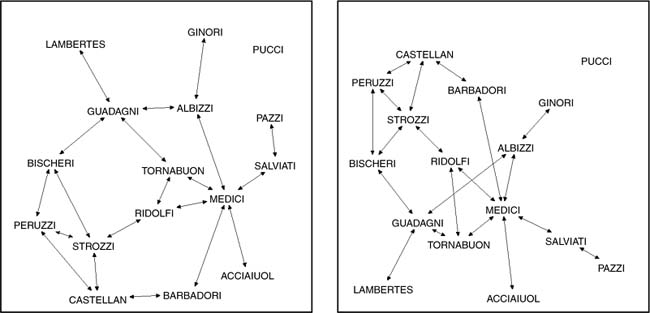
Figure 1 Two Possible Digraph Depictions of the Same Network Data
It is impossible to write statistical software without using algorithms, so the importance of algorithms to quantitative methodologists is ensured. However, user friendly statistical software packages eliminate the need for end users to construct their own algorithms for most tasks. Nonetheless, at least a basic understanding of algorithms can be useful. For example, maximum likelihood estimation methods can use an initial estimate as a starting point, and in some cases, failure to converge may be remediated by trivially altering the initial estimate. Without some familiarity of the underlying algorithm, a researcher may be stuck with a nonconverging function.
Another setting where some knowledge of algorithms is useful is presented in Figure 1, which shows two possible digraph depictions of the same network data. The left panel uses the multidimensional scaling algorithm, and the right uses simulated annealing. The data are identical, which may be verified by observing who is connected to whom, but the appearance of the graphs is different. Algorithms are important here because interpretation of the network data is affected by the appearance of the graph, which is affected in turn by the choice of algorithm. Although in many cases, different algorithms will produce the same result but differ in speed, in this case, different algorithms produce different results.
The term algorithm is sometimes used more broadly to mean any step-by-step procedure to solve a given task, whether or not a computer is involved. For instance, matching historical records from more than one archival source can be done by hand using an algorithm.
References
...
- Analysis of Variance
- Association and Correlation
- Association
- Association Model
- Asymmetric Measures
- Biserial Correlation
- Canonical Correlation Analysis
- Correlation
- Correspondence Analysis
- Intraclass Correlation
- Multiple Correlation
- Part Correlation
- Partial Correlation
- Pearson's Correlation Coefficient
- Semipartial Correlation
- Simple Correlation (Regression)
- Spearman Correlation Coefficient
- Strength of Association
- Symmetric Measures
- Basic Qualitative Research
- Basic Statistics
- F Ratio
- N(n)
- t-Test
- X¯
- Y Variable
- z-Test
- Alternative Hypothesis
- Average
- Bar Graph
- Bell-Shaped Curve
- Bimodal
- Case
- Causal Modeling
- Cell
- Covariance
- Cumulative Frequency Polygon
- Data
- Dependent Variable
- Dispersion
- Exploratory Data Analysis
- Frequency Distribution
- Histogram
- Hypothesis
- Independent Variable
- Measures of Central Tendency
- Median
- Null Hypothesis
- Pie Chart
- Regression
- Standard Deviation
- Statistic
- Causal Modeling
- DISCOURSE/CONVERSATION ANALYSIS
- Econometrics
- Epistemology
- Ethnography
- Evaluation
- Event History Analysis
- Experimental Design
- Factor Analysis and Related Techniques
- Feminist Methodology
- Generalized Linear Models
- HISTORICAL/COMPARATIVE
- Interviewing in Qualitative Research
- Latent Variable Model
- LIFE HISTORY/BIOGRAPHY
- LOG-LINEAR MODELS (CATEGORICAL DEPENDENT VARIABLES)
- Longitudinal Analysis
- Mathematics and Formal Models
- Measurement Level
- Measurement Testing and Classification
- Multilevel Analysis
- Multiple Regression
- Qualitative Data Analysis
- Sampling in Qualitative Research
- Sampling in Surveys
- Scaling
- Significance Testing
- Simple Regression
- Survey Design
- Time Series
- ARIMA
- Box-Jenkins Modeling
- Cointegration
- Detrending
- Durbin-Watson Statistic
- Error Correction Models
- Forecasting
- Granger Causality
- Interrupted Time-Series Design
- Intervention Analysis
- Lag Structure
- Moving Average
- Periodicity
- Serial Correlation
- Spectral Analysis
- Time-Series Cross-Section (TSCS) Models
- Time-Series Data (Analysis/Design)
- Trend Analysis
Get a 30 day FREE TRIAL
-
 Watch videos from a variety of sources bringing classroom topics to life
 -
Read modern, diverse business cases
-
Explore hundreds of books and reference titles

Read next

More like this
Sage Recommends
We found other relevant content for you on other Sage platforms.
Have you created a personal profile? Login or create a profile so that you can save clips, playlists and searches