
Entry
Reader's guide
Entries A-Z
Subject index
Phi Coefficient
The phi coefficient (represented symbolically as φ) is a test of the relationship or association between two dichotomous variables. In other words, both variables have only two, mutually exclusive responses options, such as yes/no or left-handed/right-handed. The phi coefficient ranges from −1 to +1, with negative numbers representing negative relationships, zero representing no relationship, and positive numbers representing positive relationships. This entry discusses the setup, calculation, and interpretation of a phi coefficient. It concludes by presenting a brief example using communication variables.
Setup and Calculation of a Phi Coefficient
To compute a phi coefficient, two variables must be used, each with dichotomous response options. This produces what is called a 2 × 2 (two variables, each with two response options) contingency table, which displays the variables, their frequencies, and the totals. Here is an example of such a table, with “yes” and “no” response options for both variables:
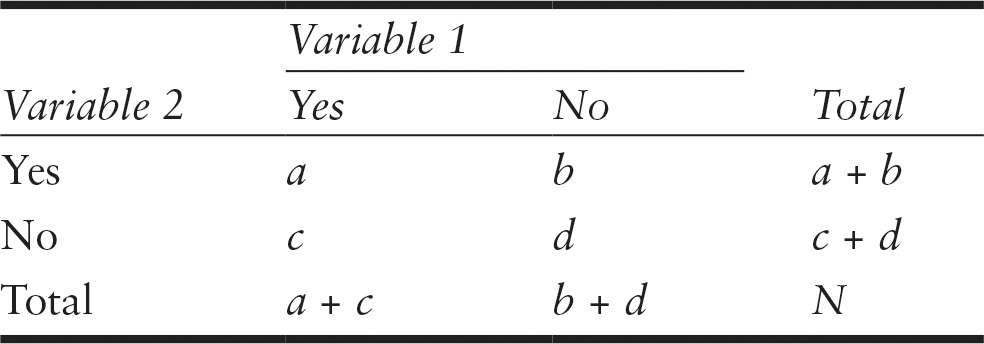
By examining the frequencies of the 2 × 2 contingency table, the direction of the relationship (i.e., positive or negative) can be surmised. Specifically, if the bulk of responses fall in the a and d cells, the relationship will be positive; conversely, if the responses largely fall in cells b and c, the relationship will be negative. In addition to the requirement that both variables are measured dichotomously, the row and column totals of the 2 × 2 contingency table must be the same (i.e., [a + b] + [c + d] = [a + c] + [b + d]). Only after these two criteria have been met can a phi coefficient be calculated, which is done using the following equation:
After the phi coefficient is calculated (a number which should range between −1 and +1), a chi-square statistic must be used to test for significance (i.e., did the association occur by chance or is it systematic?). The phi coefficient must be converted to a chi-square (χ2) using the following equation: χ2 = Nφ2, where N is the total number of cases (see the example 2 × 2 contingency table). In addition, the degrees of freedom (df) for the test are needed, and are calculated using the following equation: (r − 1)(c − 1), where r is the number of rows and c is the number of columns. For a 2 × 2 contingency table, the df will always equal 1, as (2 − 1) (2 − 1) = 1, and a phi coefficient cannot be utilized on variables with more than two response options. After the phi coefficient has been converted to a chi-square and the df obtained, the chi-square value can be compared to the critical value for the test, and a conclusion about statistical significance made.
...
- Creating and Conducting Research
- Creation of Research Project
- Authoring: Telling a Research Story
- Body Image and Eating Disorders
- Hypothesis Formulation
- Methodology, Selection of
- Program Assessment
- Research Ideas, Sources of
- Research Project, Planning of
- Research Question Formulation
- Research Topic, Definition of
- Research, Inspiration for
- Social Media: Blogs, Microblogs, and Twitter
- Testability
- Ethics
- Acknowledging the Contribution of Others
- Activism and Social Justice
- Anonymous Source of Data
- Authorship Bias
- Authorship Credit
- Confidentiality and Anonymity of Participants
- Conflict of Interest in Research
- Controversial Experiments
- Copyright Issues in Research
- Cultural Sensitivity in Research
- Data Security
- Debriefing of Participants
- Deception in Research
- Ethical Issues, International Research
- Ethics Codes and Guidelines
- Fraudulent and Misleading Data
- Funding Research
- Health Care Disparities
- Human Subjects, Treatment of
- Informed Consent
- Institutional Review Board
- Organizational Ethics
- Peer Review
- Plagiarism
- Plagiarism, Self-
- Privacy of Information
- Privacy of Participants
- Public Behavior, Recording of
- Reliability, Unitizing
- Research Ethics and Social Values
- Researcher-Participant Relationships
- Social Implications of Research
- Literature Reviews
- Archive Searching for Research
- Bibliographic Research
- Databases, Academic
- Foundation and Government Research Collections
- Library Research
- Literature Review, The
- Literature Reviews, Foundational
- Literature Reviews, Resources for
- Literature Reviews, Strategies for
- Literature Sources, Skeptical and Critical Stance Toward
- Literature, Determining Quality of
- Literature, Determining Relevance of
- Meta-Analysis
- Publications, Scholarly
- Search Engines for Literature Search
- Vote Counting Literature Review Methods
- Writing and Publishing Research
- Abstract or Executive Summary
- Academic Journals
- Alternative Conference Presentation Formats
- American Psychological Association (APA) Style
- Archiving Data
- Blogs and Research
- Chicago Style
- Citations to Research
- Evidence-Based Policy Making
- Invited Publication
- Limitations of Research
- Modern Language Association (MLA) Style
- Narrative Literature Review
- New Media Analysis
- News Media, Writing for
- Panel Presentations and Discussion
- Pay to Review and/or Publish
- Peer Reviewed Publication
- Poster Presentation of Research
- Primary Data Analysis
- Publication Style Guides
- Publication, Politics of
- Publications, Open-Access
- Publishing a Book
- Publishing a Journal Article
- Research Report, Organization of
- Research Reports, Objective
- Research Reports, Subjective
- Scholarship of Teaching and Learning
- Secondary Data
- Submission of Research to a Convention
- Submission of Research to a Journal
- Title of Manuscript, Selection of
- Visual Images as Data Within Qualitative Research
- Writer’s Block
- Writing a Discussion Section
- Writing a Literature Review
- Writing a Methods Section
- Writing a Results Section
- Writing Process, The
- Creation of Research Project
- Designing the Empirical Inquiry
- Content Analysis
- Coding of Data
- Content Analysis, Definition of
- Content Analysis, Process of
- Content Analysis: Advantages and Disadvantages
- Conversation Analysis
- Critical Analysis
- Discourse Analysis
- Interaction Analysis, Quantitative
- Intercoder Reliability
- Intercoder Reliability Coefficients, Comparison of
- Intercoder Reliability Standards: Reproducibility
- Intercoder Reliability Standards: Stability
- Intercoder Reliability Techniques: Cohen’s Kappa
- Intercoder Reliability Techniques: Fleiss System
- Intercoder Reliability Techniques: Holsti Method
- Intercoder Reliability Techniques: Krippendorf Alpha
- Intercoder Reliability Techniques: Percent Agreement
- Intercoder Reliability Techniques: Scott’s Pi
- Metrics for Analysis, Selection of
- Narrative Analysis
- Observational Research Methods
- Observational Research, Advantages and Disadvantages
- Observer Reliability
- Rhetorical and Dramatism Analysis
- Semiotics
- Unobtrusive Analysis
- Internet Inquiry
- Association of Internet Researchers (AoIR)
- Chat Rooms
- Computer-Mediated Communication (CMC)
- Internet as Cultural Context
- Internet Research and Ethical Decision Making
- Internet Research, Privacy of Participants
- Online and Offline Data, Comparison of
- Online Communities
- Online Data, Collection and Interpretation of
- Online Data, Documentation of
- Online Data, Hacking of
- Online Interviews
- Online Social Worlds
- Social Networks, Online
- Spam
- Measurement
- Correspondence Analysis
- Cutoff Scores
- Data Cleaning
- Data Reduction
- Data Trimming
- Facial Affect Coding System
- Factor Analysis
- Factor Analysis-Oblique Rotation
- Factor Analysis: Confirmatory
- Factor Analysis: Evolutionary
- Factor Analysis: Exploratory
- Factor Analysis: Internal Consistency
- Factor Analysis: Parallelism Test
- Factor Analysis: Rotated Matrix
- Factor Analysis: Varimax Rotation
- Implicit Measures
- Measurement Levels
- Measurement Levels, Interval
- Measurement Levels, Nominal/Categorical
- Measurement Levels, Ordinal
- Measurement Levels, Ratio
- Observational Measurement: Face Features
- Observational Measurement: Proxemics and Touch
- Observational Measurement: Vocal Qualities
- Organizational Identification
- Outlier Analysis
- Parsimony
- Physiological Measurement
- Physiological Measurement: Blood Pressure
- Physiological Measurement: Genital Blood Volume
- Physiological Measurement: Heart Rate
- Physiological Measurement: Pupillary Response
- Physiological Measurement: Skin Conductance
- Range
- Raw Score
- Reaction Time
- Reliability of Measurement
- Reliability, Cronbach’s Alpha
- Reliability, Knuder-Richardson
- Reliability, Split-half
- Scales, Forced Choice
- Scales, Likert Statement
- Scales, Open-Ended
- Scales, Rank Order
- Scales, Semantic Differential
- Scales, True/False
- Scaling, Guttman
- Standard Score
- Time Series Notation
- True Score
- Validity, Concurrent
- Validity, Construct
- Validity, Face and Content
- Validity, Halo Effect
- Validity, Measurement of
- Validity, Predictive
- Variables, Conceptualization
- Variables, Operationalization
- Z Transformation
- Research Subjects/Participants
- Sampling
- Survey Research
- Opinion Polling
- Sampling, Random
- Survey Instructions
- Survey Questions, Writing and Phrasing of
- Survey Response Rates
- Survey Wording
- Survey: Contrast Questions
- Survey: Demographic Questions
- Survey: Dichotomous Questions
- Survey: Filter Questions
- Survey: Follow-up Questions
- Survey: Leading Questions
- Survey: Multiple-Choice Questions
- Survey: Negative-Wording Questions
- Survey: Open-Ended Questions
- Survey: Questionnaire
- Survey: Sampling Issues
- Survey: Structural Questions
- Surveys, Advantages and Disadvantages of
- Surveys, Using Others’
- Under-represented Group
- Content Analysis
- Qualitatively Examining Information
- Qualitative Concepts and Techniques
- Alternative News Media
- Analytic Induction
- Archival Analysis
- Artifact Selection
- Autoethnography
- Axial Coding
- Burkean Analysis
- Case Study
- Close Reading
- Coding, Fixed
- Coding, Flexible
- Computer-Assisted Qualitative Data Analysis Software (CAQDAS)
- Covert Observation
- Critical Ethnography
- Critical Incident Method
- Critical Race Theory
- Cultural Studies and Communication
- Demand Characteristics
- Ethnographic Interview
- Ethnography
- Ethnomethodology
- Fantasy Theme Analysis
- Feminist Analysis
- Field Notes
- First Wave Feminism
- Fisher Narrative Paradigm
- Focus Groups
- Frame Analysis
- Garfinkling
- Gender-Specific Language
- Grounded Theory
- Hermeneutics
- Historical Analysis
- Ideographs
- Induction
- Informant Interview
- Interaction Analysis, Qualitative
- Interpretative Research
- Interviews for Data Gathering
- Interviews, Recording and Transcribing
- Journals
- Marxist Analysis
- Meta-ethnography
- Metaphor Analysis
- Narrative Interviewing
- Naturalistic Observation
- Negative Case Analysis
- Neo-Aristotelian Method
- New Media and Participant Observation
- Participant Observer
- Pentadic Analysis
- Performance Research
- Phenomenological Traditions
- Poetic Analysis
- Postcolonial Analysis
- Power in Language
- Pronomial Use-Solidarity
- Psychoanalytic Approaches to Rhetoric
- Public Memory
- Qualitative Data
- Queer Methods
- Queer Theory
- Researcher-Participant Relationships in Observational Research
- Respondent Interviews
- Rhetoric as Epistemic
- Rhetoric, Aristotle’s: Ethos
- Rhetoric, Aristotle’s: Logos
- Rhetoric, Aristotle’s: Pathos
- Rhetoric, Isocrates’
- Rhetorical Artifact
- Rhetorical Method
- Rhetorical Theory
- Second Wave Feminism
- Snowball Subject Recruitment
- Social Constructionism
- Social Network Analysis
- Spontaneous Decision Making
- Symbolic Interactionism
- Synecdoche
- Terministic Screens
- Textual Analysis
- Thematic Analysis
- Theoretical Traditions
- Third-Wave Feminism
- Transcription Systems
- Triangulation
- Turning Point Analysis
- Unobtrusive Measurement
- Visual Materials, Analysis of
- Qualitative Concepts and Techniques
- Statistically Analyzing Data
- Analysis of Variance Approaches
- t-Test
- t-Test, Independent Samples
- t-Test, One Sample
- t-Test, Paired Samples
- Analysis of Covariance (ANCOVA)
- Analysis of Ranks
- Analysis of Variance (ANOVA)
- Bonferroni Correction
- Chi-Square
- Decomposing Sums of Squares
- Error Term
- Eta Squared
- Factorial Analysis of Variance
- McNemar Test
- One-Tailed Test
- One-Way Analysis of Variance
- Post Hoc Tests
- Post Hoc Tests: Duncan Multiple Range Test
- Post Hoc Tests: Least Significant Difference
- Post Hoc Tests: Scheffe Test
- Post Hoc Tests: Student-Newman-Keuls Test
- Post Hoc Tests: Tukey Honestly Significance Difference Test
- Repeated Measures
- Experimental Design Issues
- p value
- Between-Subjects Design
- Blocking Variable
- Causality
- Control Groups
- Counterbalancing
- Cross-Sectional Design
- Data
- Degrees of Freedom
- Delayed Measurement
- Ex Post Facto Designs
- Experimental Manipulation
- Experiments and Experimental Design
- External Validity
- Extraneous Variables, Control of
- Factor, Crossed
- Factor, Fixed
- Factor, Nested
- Factor, Random
- Factorial Designs
- False Negative
- False Positive
- Field Experiments
- Hierarchical Model
- Individual Difference
- Internal Validity
- Laboratory Experiments
- Latin Square Design
- Longitudinal Design
- Manipulation Check
- Measures of Variability
- Median Split of Sample
- Mixed Level Design
- Multitrial Design
- Null Hypothesis
- One-Group Pretest–Posttest Design
- Orthogonality
- Overidentified Model
- Pilot Study
- Population/Sample
- Power Curves
- Quantitative Research, Purpose of
- Quantitative Research, Steps for
- Quasi-Experimental Design
- Random Assignment
- Replication
- Research Proposal
- Rigor
- Sampling Theory
- Sampling, Determining Size
- Solomon Four-Group Design
- Stimulus Pre-test
- Two-Group Pretest–Posttest Design
- Two-Group Random Assignment Pretest–Posttest Design
- Variables, Control
- Variables, Dependent
- Variables, Independent
- Variables, Latent
- Variables, Marker
- Variables, Mediating Types
- Variables, Moderating Types
- Within-Subjects Design
- Linear Approaches to Statistics
- Analysis of Residuals
- Bivariate Statistics
- Bootstrapping
- Confidence Interval
- Conjoint Analysis
- Contrast Analysis
- Correlation, Pearson
- Correlation, Point-Biserial
- Correlation, Spearman
- Covariance/Variance Matrix
- Covariate
- Cramér’s V
- Discriminant Analysis
- Kendall’s Tau
- Kruskal-Wallis Test
- Linear Regression
- Linear Versus Nonlinear Relationships
- Multicollinearity
- Multiple Regression
- Multiple Regression: Block Analysis
- Multiple Regression: Covariates in Multiple Regression
- Multiple Regression: Multiple R
- Multiple Regression: Standardized Regression Coefficient
- Partial Correlation
- Phi Coefficient
- Semi-Partial r
- Simple Bivariate Correlation
- Statistical Measurement Issues
- Z score
- Categorization
- Cluster Analysis
- Data Transformation
- Errors of Measurement
- Errors of Measurement: Attenuation
- Errors of Measurement: Ceiling and Floor Effects
- Errors of Measurement: Dichotomization of a Continuous Variable
- Errors of Measurement: Range Restriction
- Errors of Measurement: Regression Toward the Mean
- Frequency Distributions
- Heterogeneity of Variance
- Heteroskedasticity
- Homogeneity of Variance
- Hypothesis Testing, Logic of
- Intraclass Correlation
- Mean, Arithmetic
- Mean, Geometric
- Mean, Harmonic
- Measures of Central Tendency
- Median
- Mode
- Mortality in Sample
- Normal Curve Distribution
- Relationships Between Variables
- Sampling, Probability
- Sensitivity Analysis
- Significance Test
- Simple Descriptive Statistics
- Skewness
- Standard Deviation and Variance
- Standard Error
- Standard Error, Mean
- Statistical Power Analysis
- Type I error
- Type II error
- Univariate Statistics
- Variables, Categorical
- Variables, Continuous
- Variables, Defining
- Variables, Interaction of
- Statistical Models
- Autoregressive, Integrative, Moving Average (ARIMA) Models
- Binomial Effect Size Display
- Cloze Procedure
- Cross Validation
- Cross-Lagged Panel Analysis
- Curvilinear Relationship
- Effect Sizes
- Hierarchical Linear Modeling
- Lag Sequential Analysis
- Lambda
- Log-Linear Analysis
- Logistic Analysis
- Margin of Error
- Markov Analysis
- Maximum Likelihood Estimation
- Meta-Analysis: Estimation of Average Effect
- Meta-Analysis: Fixed Effects Analysis
- Meta-Analysis: Literature Search Issues
- Meta-Analysis: Model Testing
- Meta-Analysis: Random Effects Analysis
- Meta-Analysis: Statistical Conversion to Common Metric
- Multivariate Analysis of Variance (MANOVA)
- Multivariate Statistics
- Odds Ratio
- Ordinary Least Squares
- Path Analysis
- Probit Analysis
- Quasi-F
- Sobel Test
- Structural Equation Modeling
- Time-Series Analysis
- Analysis of Variance Approaches
- Understanding the Scope of Communication Research
- Areas of Inquiry
- Acculturation
- African American Communication and Culture
- Agenda Setting
- Applied Communication
- Argumentation Theory
- Asian/Pacific American Communication Studies
- Bad News, Communication of
- Basic Course in Communication
- Business Communication
- Communication and Aging Research
- Communication and Culture
- Communication and Evolution
- Communication and Future Studies
- Communication and Human Biology
- Communication and Technology
- Communication Apprehension
- Communication Assessment
- Communication Competence
- Communication Education
- Communication Ethics
- Communication History
- Communication Privacy Management Theory
- Communication Skills
- Communication Theory
- Conflict, Mediation, and Negotiation
- Corporate Communication
- Crisis Communication
- Cross-Cultural Communication
- Cultural Studies and Communication
- Cyberchondria
- Dark Side of Communication
- Debate and Forensics
- Development of Communication in Children
- Diaspora
- Digital Media and Race
- Digital Natives
- Dime Dating
- Disability and Communication
- Distance Learning
- Educational Technology
- Emergency Communication
- Empathic Listening
- English as a Second Language
- Environmental Communication
- Family Communication
- Feminist Communication Studies
- Film Studies
- Financial Communication
- Freedom of Expression
- Game Studies
- Gender and Communication
- GeoMedia
- GLBT Communication Studies
- GLBT Social Media
- Group Communication
- Health Communication
- Health Literacy
- Human-Computer Interaction
- Instructional Communication
- Intercultural Communication
- Intergenerational Communication
- Intergroup Communication
- International Communication
- International Film
- Interpersonal Communication
- Intrapersonal Communication
- Jealousy
- Journalism
- Language and Social Interaction
- Latino Communication
- Leadership
- Legal Communication
- Managerial Communication
- Mass Communication
- Massive Multiplayer Online Games
- Massive Open Online Courses
- Media and Technology Studies
- Media Diffusion
- Media Effects Research
- Media Literacy
- Message Production
- Multiplatform Journalism
- Native American or Indigenous Peoples Communication
- Nonverbal Communication
- Organizational Communication
- Parasocial Communication
- Passing
- Patient-Centered Communication
- Peace Studies
- Performance Studies
- Personal Relationship Studies
- Persuasion
- Philosophy of Communication
- Politeness
- Political Communication
- Political Debates
- Political Economy of Media
- Popular Communication
- Pornography and Research
- Propaganda
- Public Address
- Public Relations
- Reality Television
- Relational Dialectics Theory
- Religious Communication
- Rhetoric
- Rhetorical Genre
- Risk Communication
- Robotic Communication
- Science Communication
- Selective Exposure
- Service Learning
- Small Group Communication
- Social Cognition
- Social Network Systems
- Social Presence
- Social Relationships
- Spirituality and Communication
- Sports Communication
- Strategic Communication
- Structuration Theory
- Surrogacy
- Terrorism
- Training and Development in Organizations
- Video Games
- Visual Communication Studies
- Wartime Communication
- Structure of Research Community
- Areas of Inquiry
- Loading...
Get a 30 day FREE TRIAL
-
 Watch videos from a variety of sources bringing classroom topics to life
 -
Read modern, diverse business cases
-
Explore hundreds of books and reference titles

Read next

More like this
Sage Recommends
We found other relevant content for you on other Sage platforms.
Have you created a personal profile? Login or create a profile so that you can save clips, playlists and searches