
Entry
Reader's guide
Entries A-Z
Subject index
Ladder of Inference
The ladder of inference is a key tool of Action Science—one approach to action research. The ladder is a model of our reasoning steps as we assess a situation and decide what action to take (Figure 1). This entry describes the features of the ladder and how it can be used to help people reflect on their behaviour and the reasoning behind it.
Figure 1 Ladder of Inference: How We Think
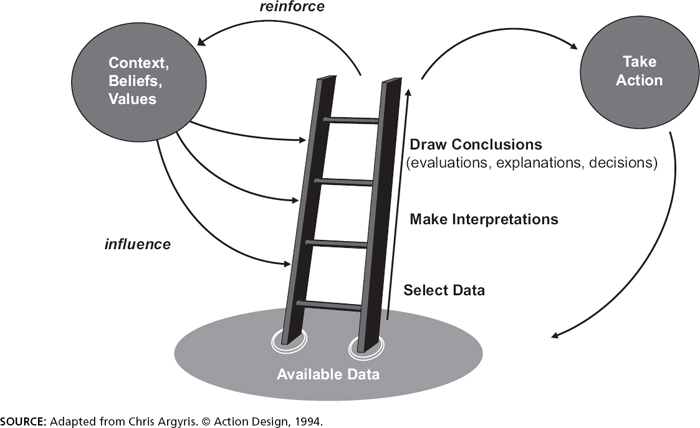
At the bottom of the ladder are the available data: numbers on a spreadsheet, the content of a memo, what others say, their non-verbal behaviour and so on. Given the limits of the mind, humans cannot pay attention to everything. They select, often without being aware of it, the information that is most salient and ignore the rest (first rung). Next, they interpret what that data means (second rung), and from these meanings, they draw conclusions: They evaluate, explain, make predictions and decide what to do (third rung). Based on the decisions they make, they then take action, and these actions become part of the data pool from which they draw further inferences. This is particularly important in interpersonal interaction. While they are typically aware of how others' actions affect them, individuals are often not aware of their own actions and their impact on others. Yet the actions they take become data that others use to make inferences, attributions and evaluations about them, which may be different from what those individuals hope for or intend.
Chris Argyris developed the ladder of inference as a tool for double-loop learning—learning that produces change in values and assumptions, not simply behaviour change. Initially developed for research and intervention, it is useful for anyone engaged in a difficult conversation where the quality of the conversation is critical for effective action. While there are alternative versions of the ladder of inference in the literature, all of them have a common focus and purpose: how people make inferences and the need to make inferences explicit so that errors in reasoning can be discovered and corrected.
A premise of Action Science is that any action with an intended consequence is informed by reasoning, and the effectiveness of action depends on the quality of reasoning. The difficulty with improving reasoning is that it is often invisible. Individuals ‘go up our ladder’ so quickly—at the speed of thought—that they are not aware of their interpretations and inferences. Their conclusions feel obvious; therefore, they see no need to check the validity of the conclusions.
How individuals move up their ladders of inference—from data to interpretations, to conclusions—is not random or accidental. Their inferences are influenced by past experience, current context, emotional state, values and assumptions. For example, in some cultures, arriving at a meeting after the scheduled start time is considered late and is reprimanded. In others, it goes unnoticed. If a subordinate says, ‘We need to do X to solve Y’, it is a request for resources. If the boss says the same, she is giving orders.
...
- Alinsky, Saul
- Argyris, Chris
- Bateson, Gregory
- Boal, Augusto
- Chataway, Cynthia Joy
- Dewey, John
- Emery, Fred
- Fals Borda, Orlando
- Freire, Paulo
- Gadamer, Hans-Georg
- Horton, Myles
- Kincheloe, Joe
- Lewin, Kurt
- marino, dian
- Martín-Baró, Ignacio
- Nielsen, Kurt Aagaard
- Noffke, Susan
- Schön, Donald
- Toulmin, Stephen
- Whyte, William Foote
- Wittgenstein, Ludwig
- Academic Discourse
- Agency
- Appreciative Intelligence
- Authenticity
- Bakhtinian Dialogism
- Bildung
- Community of Inquiry
- Communities of Practice
- Conscientization
- Critical Friend
- Critical Reference Group
- Dialogue
- Double-Loop Learning
- Empowerment
- Engaged Scholarship
- Hegemony
- Heteroglossia
- Heutagogy
- Identity
- Knowledge Democracy
- Metaphor
- Non-Indigenous Ally
- Organizational Culture
- Positionality
- Subalternity
- Sustainability
- Systems Thinking
- Tacit Knowledge
- Taylorism
- Technical Action Research
- Tempered Radical
- Transformative Learning
- Vivencia
- Voice
- Epistemology
- Experiential Knowing
- Experiential Learning
- Extended Epistemology
- Hawaiian Epistemology
- Māori Epistemology
- Practical Knowing
- Ubuntu
- Covenantal Ethics
- Ethics and Moral Decision-Making
- Feminist Ethics
- Indigenous Research Ethics and Practice
- Institutional Review Board
- Capacity Building
- Citizen Participation
- Co-Generative Learning
- Environmental Justice
- Knowledge Mobilization
- Local Self-Governance
- Social Accountability
- Social Justice
- Women's Political Empowerment
- Action Evaluation
- Advocacy and Inquiry
- Autobiography
- Bricolage Process
- Case Study
- Citizen Report Card
- Citizens' Juries
- Cognitive Mapping
- Collaborative Data Analysis
- Community Dialogue
- Community Mapping
- Computer-Based Instruction
- Concept Mapping
- Conflict Management
- Convergent Interviewing
- Critical Reflection
- Democratic Dialogue
- Descriptive Review
- Development Coalitions
- Dialogue Conferences
- Digital Storytelling
- Discourse Analysis
- Fishbone Diagram
- Focus Groups
- Interviews
- Journaling
- Listening Guide
- Microplanning
- Multi-Stakeholder Dialogue
- Narrative Inquiry
- Organizational Storytelling
- Participatory Monitoring
- Photovoice
- Research Circles
- Search Conference
- Social Audit
- Stakeholder Analysis
- Storytelling
- World Café, The
- Action Learning
- Action Science
- Anti-Oppression Research
- Appreciative Inquiry and Research Methodology
- Appreciative Inquiry and Sustainable Value Creation
- Arts-Based Action Research
- Asset-Based Community Development
- Citizen Science
- Classroom-Based Action Research
- Clinical Inquiry
- Collaborative Action Research
- Collaborative Developmental Action Inquiry
- Collaborative Management Research
- Community-Based Participatory Research
- Community-Based Research
- Comprehensive District Planning
- Co-Operative Inquiry
- Critical Action Learning
- Critical Participatory Action Research
- Critical Utopian Action Research
- Dialogic Inquiry
- Ethnography
- Evaluative Inquiry
- Feminist Participatory Action Research
- First Person Action Research
- Grounded Theory
- Indigenist Research
- Indigenous Research Methods
- Interactive Research
- Intervention Research in Management
- Large-Group Action Research
- Learning History
- Living Life as Inquiry
- Narrative
- Oral History
- Participatory Action Research
- Participatory Design Programming
- Participatory Governance
- Participatory Learning and Action
- Participatory Rapid Appraisal
- Participatory Rural Appraisal
- Participatory Theatre
- Participatory Urban Planning
- Performed Ethnography
- Practice Development
- Practitioner Inquiry
- Pragmatic Action Research
- Process Consultation
- Qualimetrics Intervention Research
- Quantitative Methods
- Reflective Practice
- Second Person Action Research
- Soft Systems Methodology
- Strategic Planning
- Strengths-Based Approach
- Systemic Action Research
- Systems Psychodynamics
- Theatre of the Oppressed
- Third Person Action Research
- Transpersonal Inquiry
- Work-Based Learning
- Youth Participatory Action Research
- Cycles of Action and Reflection
- Data Analysis
- Disseminating Action Research
- Gender Issues
- Generalizability
- Information and Communications Technology and Organizational Change
- Integrating Grounded Theory
- Intersubjectivity
- Meta-Methodology
- Mode 1 and Mode 2 Knowledge Production
- Quality
- Reliability
- Rigour
- Transferability
- Validity
- Antigonish Movement
- Centre for Action Research in Professional Practice
- Collaborative Action Research Network
- Community Design Centres
- Community-University Partnership Programme
- Community-Campus Partnerships for Health
- Community-University Research Partnerships
- Cornell Participatory Action Research Network
- Dig Where You Stand Movement
- Disabled People's Organizations
- Global Alliance for Community-Engaged Research
- Gonogobeshona
- Grameen Bank
- Highlander Research and Education Center
- Institute of Development Studies
- International Council for Adult Education
- International Participatory Research Network
- Jipemoyo Project
- LGBT
- Maya Women of Chajul
- Mondragón Co-Operatives
- Norwegian Industrial Democracy Movement
- Office of Community-Based Research
- Research Initiatives, Bangladesh
- Social Movement Learning Movement
- Society for Participatory Research in Asia
- Tavistock Institute
- Work Research Institute, The
- World Congresses of Action Research
- Action Turn, The
- Aesthetics
- Communitarianism
- Critical Constructivism
- Critical Pedagogy
- Critical Race Theory
- Critical Realism
- Frankfurt School
- Hermeneutics
- Ontology
- Phenomenology
- Philosophy of Science
- Phrónêsis
- Positive Organizational Scholarship and Appreciative Inquiry
- Praxeology
- Praxis
- Téchnê
- Action Anthropology
- Adult Education
- Agriculture and Ecological Integrity
- Community Development
- Criminal Justice Systems
- Design Research
- Development Action Research
- Educational Action Research
- Environment and Climate Change
- Evaluation
- Health Care
- Health Education
- Health Promotion
- Higher Education
- HIV Prevention and Support
- Human Rights
- Information Systems
- Insider Action Research
- Inter-Organizational Action Research
- Labour-Managed Firms
- New Product Development
- Nursing
- Operations Management
- Organization Development
- Participatory Disaster Management
- Project Management
- Regional Development
- Subaltern Studies
- Voluntary Sector
- Workers' Participation in Occupational Health and Safety
- Work-Family Interventions
- Dissertation Writing
- Facilitation
- Supervising Action Research Theses and Dissertations
- Teaching Action Researchers
- Christian Spirituality of Action
- Confucian Principles
- Islamic Practice
- Jewish Belief, Thought and Practice
- Karma Theory
- Liberation Theology
- Mindful Inquiry
- Theological Action Research
- Activity Theory
- Complexity Theory
- Constructivism
- Feminism
- Field Theory
- Humanism
- Liberation Psychology
- Living Theories
- Marxism
- Post-Colonial Theory
- Postmodernism
- Pragmatism
- Relational-Cultural Theory
- Social Constructionism
- Social Learning
- Socio-Technical Systems
- Symbolic Interactionism
- Theories of Action
- Asset Mapping
- Force Field Analysis
- Geographic Information Systems
- Ladder of Inference
- Ladder of Participation
- Learning Pathways Grid
- Loading...
Get a 30 day FREE TRIAL
-
 Watch videos from a variety of sources bringing classroom topics to life
 -
Read modern, diverse business cases
-
Explore hundreds of books and reference titles

Read next

More like this
Sage Recommends
We found other relevant content for you on other Sage platforms.
Have you created a personal profile? Login or create a profile so that you can save clips, playlists and searches