
Entry
Entries A-Z
a priori comparisons or tests
where there are three or more means that may be compared (e.g. analysis of variance with three groups), one strategy is to plan the analysis in advance of collecting the data (or examining them). So, in this context, a priori means before the data analysis. (Obviously this would only apply if the researcher was not the data collector, otherwise it is in advance of collecting the data.) This is important because the process of deciding what groups are to be compared should be on the basis of the hypotheses underlying the planning of the research. By definition, this implies that the researcher is generally disinterested in general or trivial aspects of the data which are not the researcher's primary focus. As a consequence, just a few of the possible comparisons are needed to be made as these contain the crucial information relative to the researcher's interests. Table A.1 involves a simple ANOVA design in which there are four conditions -two are drug treatments and there are two control conditions. There are two control conditions because in one case the placebo tablet is for drug A and in the other case the placebo tablet is for drug B.
An appropriate a priori comparison strategy in this case would be:
- Meana against Meanb
- Meana against Meanc
- Meanb against Meand
Table A.1 A simple ANOVA design
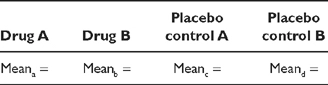
Notice that this is fewer than the maximum number of comparisons that could be made (a total of six). This is because the researcher has ignored issues which perhaps are of little practical concern in terms of evaluating the effectiveness of the different drugs. For example, comparing placebo control A with placebo control B answers questions about the relative effectiveness of the placebo conditions but has no bearing on which drug is the most effective overall.
The a priori approach needs to be compared with perhaps the more typical alternative research scenario – post hoc comparisons. The latter involves an unplanned analysis of the data following their collection. While this may be a perfectly adequate process, it is nevertheless far less clearly linked with the established priorities of the research than a priori comparisons. In post hoc testing, there tends to be an exhaustive examination of all of the possible pairs of means – so in the example in Table A.1 all four means would be compared with each other in pairs. This gives a total of six different comparisons.
In a priori testing, it is not necessary to carry out the overall ANOVA since this merely tests whether there are differences across the various means. In these circumstances, failure of some means to differ from the others may produce non-significant findings due to conditions which are of little or no interest to the researcher. In a priori testing, the number of comparisons to be made has been limited to a small number of key comparisons. It is generally accepted that if there are relatively few a priori comparisons to be made, no adjustment is needed for the number of comparisons made. One rule of thumb is that if the comparisons are fewer in total than the degrees of freedom for the main effect minus one, it is perfectly appropriate to compare means without adjustment for the number of comparisons.
...
Get a 30 day FREE TRIAL
-
 Watch videos from a variety of sources bringing classroom topics to life
 -
Read modern, diverse business cases
-
Explore hundreds of books and reference titles

Read next

More like this
Sage Recommends
We found other relevant content for you on other Sage platforms.
Have you created a personal profile? Login or create a profile so that you can save clips, playlists and searches