
Entry
Entries A-Z
logarithm
to understand logarithms, one needs also to understand what an exponent is, since a logarithm is basically an exponent. Probably the most familiar exponents are numbers like 22, 32, 42, etc. In other words, the squared 2 symbol is an exponent as obviously a cube would also be as in 23. The squared sign is an instruction to multiply (raise) the first number by itself a number of times:
22 means 2 × 2 = 4, 23 means 2 × 2 × 2 = 8. The number which is raised by the exponent is called the base. So 2 is the base in 22 or
23 or 24, while 5 is the base in 52 or 53 or 54. The logarithm of any number is given by a simple formula in which the base number is represented by the symbol b, the logarithm may be represented by the symbol e (for exponent), and the number under consideration is given the symbol x:

So a logarithm of a number is simply the exponent of a given base (which is of one's own choosing such as 10, 2, 5, etc.) which gives that number. One regularly used base for logarithms is 10. So the logarithm for the base 10 is the value of the exponent (e) for 10 which equals our chosen number. Let's suppose that we want the logarithm of the number 100 for the base 10. What we are actually seeking is the exponent of 10 which gives the number 100:

In other words, the logarithm for 100 is 2 simply because 10 to the power of 2 (i.e. 102 or 10 × 10) equals 100. Actually the logarithm would look more like other logarithms if we write it out in full as 2.000.
Logarithm tables (especially to the base 10) are readily available although their commonest use has rather declined with the advent of electronic calculators and computers – that was a simple, speedy means of multiplying numbers by adding together two logarithms. However, students will come across them in statistics in two forms:
- In log-linear analysis, which involves natural logarithms in the computation of the likelihood ratio chi-square. The base in natural logarithms is 2.718 (to three decimal places).
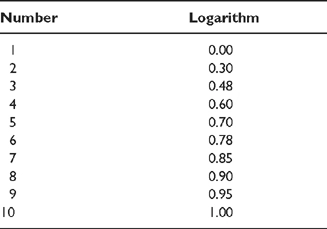
- In transformations of scores especially when the unmodified scores tend to violate the assumptions of parametric tests. Logarithms are used in this situation since it would radically alter the scale. So, the logarithm to the base 10 for the number 100 is 2.000, the logarithm of 1000 = 3.000 and the logarithm of 10,000 = 4.000. In other words, although 1000 is 10 times as large as the number 100, the logarithmic value of 1000 is 3.000 compared with 2.000 for the logarithm of 100. That is, by using logarithms it is possible to make large scores proportionally much less. So basically by putting scores on a logarithmic scale the extreme scores tend to get compacted to be relatively closer to what were much smaller scores on the untransformed measure. Logarithms
Table L.4 Logarithms to the base 10
...
Get a 30 day FREE TRIAL
-
 Watch videos from a variety of sources bringing classroom topics to life
 -
Read modern, diverse business cases
-
Explore hundreds of books and reference titles

Read next

More like this
Sage Recommends
We found other relevant content for you on other Sage platforms.
Have you created a personal profile? Login or create a profile so that you can save clips, playlists and searches