
Entry
Entries A-Z
coefficient of variation
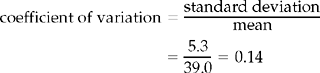
it would seem intuitive to suggest that samples with big mean scores of, say, 100 are likely to have larger variation around the mean than samples with smaller means such as 5. In order to indicate relative variability adjusting the variance of samples for their sample size, we can calculate the coefficient of variation. This is merely the standard deviation of the sample divided by the mean score. (Standard deviation itself is an index of variation, being merely the square root of variance.) This allows comparison of variation between samples with large means and small means. Essentially, it scales down (or possibly up) all standard deviations as a ratio of a single unit on the measurement scale.
Thus, if a sample mean is 39.0 and its standard deviation is 5.3, we can calculate the coefficient of variation as follows:
Despite its apparent usefulness, the coefficient of variation is more common in some disciplines than others.
Get a 30 day FREE TRIAL
-
 Watch videos from a variety of sources bringing classroom topics to life
 -
Read modern, diverse business cases
-
Explore hundreds of books and reference titles

Read next

More like this
Sage Recommends
We found other relevant content for you on other Sage platforms.
Have you created a personal profile? Login or create a profile so that you can save clips, playlists and searches